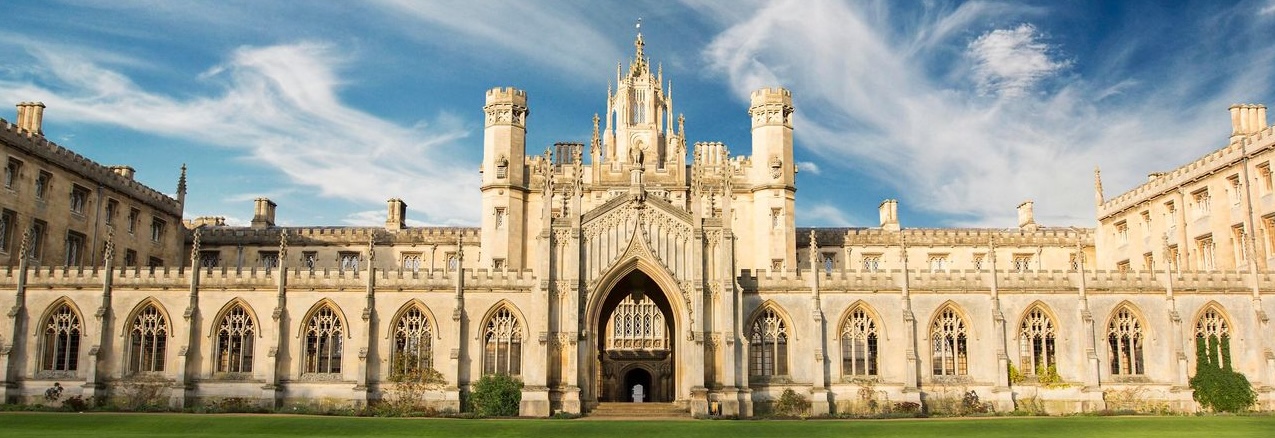
Founded in 1209, the University of Cambridge is a collegiate public research institution. Its 800-year history makes it the fourth-oldest surviving university in the world and the second-oldest university in the English-speaking world.
Cambridge serves more than 18,000 students from all cultures and corners of the world. Nearly 4,000 of its students are international and hail from over 120 different countries. In addition, the university’s International Summer Schools offer 150 courses to students from more than 50 countries.
The university is split into 31 autonomous colleges where students receive small group teaching sessions known as college supervisions.
Six schools are spread across the university’s colleges, housing roughly 150 faculties and other institutions. The six schools are: Arts and Humanities, Biological Sciences, Clinical Medicine, Humanities and Social Sciences, Physical Sciences and Technology.
The campus is located in the centre of the city of Cambridge, with its numerous listed buildings and many of the older colleges situated on or near the river Cam.
The university is home to over 100 libraries, which, between them, hold more than 15 million books in total. In the main Cambridge University library alone, which is a legal depository, there are eight million holdings. The university also owns nine arts, scientific and cultural museums that are open to the public throughout the year, as well as a botanical garden.
Cambridge University Press is a non-school institution and operates as the university’s publishing business. With over 50 offices worldwide, its publishing list is made up of 45,000 titles spanning academic research, professional development, research journals, education and bible publishing.
In total, 92 affiliates of the university have been awarded Nobel Prizes, covering every category.
The university’s endowment is valued at nearly £6 billion.
The principal aim of the Admissions Policy of the Colleges of the University of Cambridge is to offer admission to students of the highest intellectual potential, irrespective of social, racial, religious and financial considerations.
Two further aims are:
aspiration – to encourage applications from groups that are, at present, under-represented in Cambridge
fairness – to ensure that each applicant is individually assessed, without partiality or bias, in accordance with the policy on Equal Opportunities, and to ensure that, as far as possible, an applicant’s chance of admission to Cambridge does not depend on choice of College
Once students are admitted, we ensure that they’re given the academic, personal and, where appropriate, financial1 support necessary for successful completion of their course at Cambridge.
Our widening participation strategy within the UK has for a number of years focussed on trying to ensure that students with the ability to succeed at Cambridge aren’t deterred from applying by any misconceptions that may surround the University. Other activities within our diverse and extensive portfolio of outreach projects seek to introduce students to the range of degree courses we offer and to support and enrich the study of subjects at school/college.
Once students have applied then the principle detailed above takes absolute precedence. We won’t introduce quotas for people from specific backgrounds as we feel very strongly that applicants should be admitted on academic merit and potential to succeed in their chosen course.
Detailed selection criteria vary from course to course but in all we’re looking for:
academic ability and potential
motivation and suitability for the chosen course
commitment and self-discipline
Every applicant is considered individually in an holistic assessment using all the information available to us:
their academic record, including GCSE and AS (or equivalent) grades and marks and A level (or equivalent) grades or predictions, this record being considered in the context of the quality (but not type) of schools/colleges at which it was achieved
the school/college reference
the personal statement
submitted work, where requested
performance in any written assessment
contextual data
performance at interview, if interviewed
Ultimately, all admissions decisions are based on academic criteria – ability and potential – and excellence in an extra-curricular activity will never ‘compensate’ for lower academic potential.
In each subject we have moderation procedures that enable Colleges to compare the quality of their own applicants with those to other Colleges before deciding who’ll receive an offer, and our pool system provides the opportunity for applicants squeezed out by the competition at one College to receive an offer from another.
To try to ensure that all applicants and their advisers have access to up-to-date and factually correct information, we provide exhaustive information about all aspects of our admissions procedures through our extensive range of publications and our website.
The University of Cambridge has signed the UUK Fair Admissions Code of Practice.
1 Please note that financial considerations and support apply only to Home fee status students. Fees are higher for international students, and such students must be able to demonstrate in advance that they can finance themselves for their entire course without needing to undertake paid work.
The University and/or your College reserve the right to withdraw any offer made, prevent you from proceeding to matriculation or take disciplinary action which may lead to the termination of your studies if any of the information provided by you in relation to your application is found by the University or your College to be false, misleading or incomplete, or if you fail to provide satisfactory information or evidence which confirms that you can meet one or more of the conditions contained in your offer letter. This includes if we find that you were impersonated or assisted by another human or machine at interview or in an admissions test, or if any part of your application was completed by someone other than yourself and without acknowledgement.
You will need to write a personal statement for your UCAS application.
Your UCAS personal statement is your chance to tell us about your academic interests. It will help us to understand your potential as a Cambridge student.
We use personal statements to help us identify applicants with the most academic potential.
We will read your personal statement in full.
We don't give personal statements a formal score.
We consider all the information in your application. Personal statements are only one part of the Cambridge application process.
We do not expect your statement to be aimed at Cambridge alone.
If you have any information specifically for Cambridge, you can add this to the extra personal statement in My Cambridge Application.
Your UCAS personal statement will be divided into 3 sections. Find out more about the personal statement structure on the UCAS website.
We do not have a preference for how you split your personal statement between the 3 sections. But your statement should focus mostly on academic detail throughout.
Don't exaggerate. Write your statement in clear language and refer to evidence of your experiences of learning.
The space you have in your personal statement is limited. So, it's important that you use that space to strengthen your application.
Don't include lots of information about non-academic activities that are not related to your chosen course. These activities will not increase your chances of receiving a Cambridge offer, but other universities may place importance on them. Information about non-academic activities should not take up more than 20% of the section that you mention them in.
You shouldn't include lots of information about your school curriculum. You could reference how your studies have led you to develop your interests outside of school or college. But you should not reflect on your classroom based learning at length.
Talk in detail about your academic interests and motivations. You can cover these in any section of your personal statement.
Don't focus on personal motivations that are not related to your subject. For example, don't use statements like 'I have always wanted to study this subject'. Instead, write about:
why you're interested in your subject
what skills you've enjoyed developing
why the subject is a good fit for you
We want to hear about how you are exploring your academic interests outside of school or college.
There are lots of ways that you can explore your academic interests. For example, you could read widely on a subject or engage with online content like videos and podcasts. The most important thing is to spend your own time engaging academically.
Give examples of academic activities you've done or resources you've used outside of your school curriculum but don't just list activities. Talk about what you took from the activities and how they expanded your interests. It is better to focus on a few activities in detail.
This will help you to:
explain your academic reasons for wanting to study the subject
show your enthusiasm for and commitment to your chosen course
express any particular interests within the field
talk about skills you've developed that are relevant to your chosen course
Crucially, we are interested in your thoughts. What have you learned from your subject exploration?
We want to know what you:
have been thinking about
found interesting and how you followed up on that interest
learned from academic activities or materials beyond your school studies
The best personal statements show a pattern and logic in an applicant's academic engagement.
Write about:
connections between your academic interests
how one academic interest led you to another
any connections you've found between subjects that seem disconnected at first
You will have the opportunity to write a Cambridge specific personal statement in My Cambridge Application. This is much shorter than your UCAS personal statement.
You don't have to add a personal statement to your My Cambridge Application. However, we recommend that you do if the course you're applying for is significantly different from other UCAS choices.